










What Are Casino Software Providers?
A casino software provider is a company that designs, builds and supplies games to online casinos. Put simply, it’s the studio behind the game. Somebody there writes the maths model, somebody draws the symbols, somebody records that little jingle you hear on a big win. Live game providers run a physical studio instead, while everyone else relies on a random number generator (RNG). Each regulated market the provider sells into comes with its own technical and testing rules to meet, too. And casinos often don’t sign every studio one at a time. Most plug into a remote game server or an aggregator and pull the games into their lobby from there.
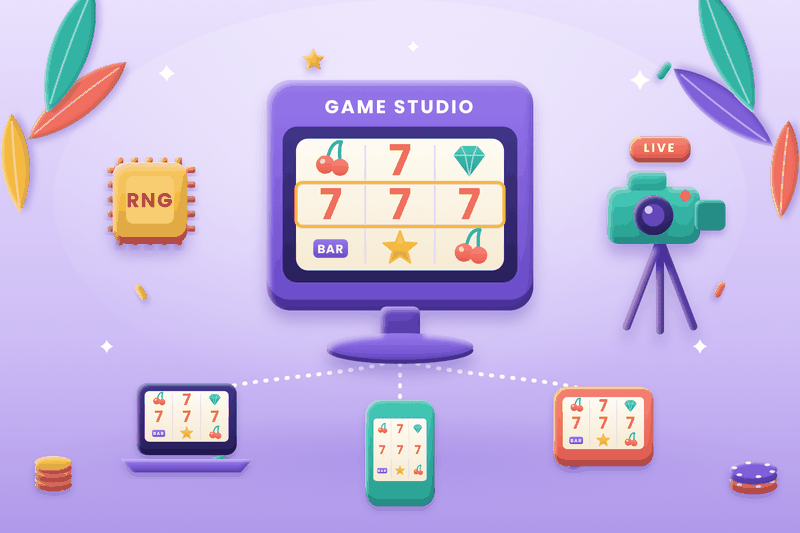
Which explains something you’ve probably noticed. The same slot looks identical at dozens of sites, because most online casino software providers sell to a lot of operators at once. The casino runs your account, your payments and your bonuses, but how the game behaves is the provider’s business. In the usual setup, the spin result comes from the provider’s server, not from anything the casino coded. Some casino software companies also own several studios, so two brands you’d think of as rivals can belong to the same group.
Top Casino Game Developers and Their Specialties
The table compares ten casino game developers whose games are widely distributed. It focuses on what each of these top casino game providers is known for rather than size or revenue, because a provider’s style tells you more about the games you will play. Specialties overlap, and most of these companies cover several formats.
| Provider | Main focus | Signature mechanics and formats | Well-known titles | Worth knowing | Provider Review |
|---|---|---|---|---|---|
| Pragmatic Play | Slots, live casino, bingo, arcade games | Tumbling and pay anywhere slots, Hold & Spin, feature buy on many titles | Gates of Olympus, Sweet Bonanza, Big Bass Bonanza | Very frequent releases; runs the Drops & Wins network promotions | Pragmatic Play review |
| Evolution | Live dealer tables and game shows | Live game shows, Lightning multiplier tables, First Person RNG games | Crazy Time, Lightning Roulette, Dream Catcher | Founded in Stockholm in 2006; parent group of several studios below | – |
| NetEnt | Video slots, RNG table games | Avalanche reels, expanding wilds, branded slots | Starburst, Gonzo’s Quest, Dead or Alive 2 | Part of the Evolution group since 2020 | NetEnt review |
| Playtech | Slots, live casino, casino platform | Networked progressive jackpots, branded live tables | Age of the Gods series, Buffalo Blitz, Great Blue | Supplies operator platform software as well as games | – |
| Play’n GO | Video slots | “Book of” expanding symbol format, cluster pays, mobile-first design | Book of Dead, Reactoonz, Rise of Olympus | Many titles are offered in more than one RTP setting | Play’n GO review |
| Hacksaw Gaming | High-volatility slots, scratchcards, instant games | Tiered bonus buys, very high max wins, stylized art | Wanted Dead or a Wild, Chaos Crew, Le Bandit | Built its name on scratch-style instant games before moving into slots | Hacksaw Gaming review |
| Nolimit City | Extreme-volatility video slots | xWays, xNudge, xBomb and other in-house mechanics | Mental, San Quentin xWays, Tombstone RIP | Part of the Evolution group since 2022 | Nolimit City review |
| PG Soft | Mobile-first slots | Portrait layouts, cascading wins, Asian themes | Fortune Tiger, Mahjong Ways, Fortune Ox | Widely played in Asian and Latin American markets | – |
| Big Time Gaming | Video slots | Megaways, licensed to other studios | Bonanza, Extra Chilli, White Rabbit | Part of the Evolution group since 2021 | Big Time Gaming review |
| Spribe | Crash and instant games | Provably fair crash format, mini games | Aviator, Mines, Plinko | Its Aviator title made the crash format mainstream | – |
One thing the table can’t show well is ownership. NetEnt, Nolimit City and Big Time Gaming? All Evolution group brands. Each one still has its own design team and its own release calendar, though. Casinos sign these deals brand by brand, too. So a site that advertises Evolution might have the live tables and none of the NetEnt slots. If you’re after a specific studio, the provider filter in the lobby is faster than guessing.
Types of Online Casino Game Software
Most casino game studios are known for one format, even if they dabble in others. That matters more than it seems. A slot isn’t built like a live blackjack table, and neither has much in common with a crash game. The tech is different, the testing is different, and so is what makes one good. Worth knowing which kind of developer you’re looking at before you compare anything.
Online Slot Software Providers
Slot developers mostly compete on mechanics and bonus design. Reels are just the start. These are the mechanics you’ll run into most:
- Cluster pays: symbols pay when they touch in a group, not along a line.
- Tumbling reels: winning symbols vanish and new ones drop in, so one spin can pay several times.
- Megaways: the number of ways to win changes on every spin.
- Hold-and-win respins: special symbols stick in place while you get a few extra spins.
- Feature buy: you pay a fixed price to jump straight into the bonus round, where that’s allowed.
Mixing two or three of them in one slot is pretty normal now, usually with free spins and multipliers stacked on top. In a lot of these games the base spins barely pay, and a big chunk of the total return sits in the bonus round. Worth knowing before you set a budget.
Each studio has a recognizable approach. NetEnt and Play’n GO made their names with polished games that appeal to a wide audience. Nolimit City and Hacksaw Gaming go the other way and build for players who’ll sit through long dry spells for a shot at a huge max win. Big Time Gaming licenses its Megaways engine to other developers. That’s why you’ll see Megaways under all sorts of logos. Want a feel for different studios without spending anything? Demo versions of free online slots are the easiest place to start. Ready for real stakes? The real money slot games section sorts every title by feature and provider.
Live Casino Software Developers
Live dealer software is part TV production, part game engine. There’s a real dealer with real cards or a real wheel. Cameras film the round. Then optical character recognition reads the result (the card value, the winning number) and passes it to the game so bets can be settled. It’s slower by design. Live blackjack will never move at RNG speed, and it isn’t supposed to.
Evolution is still the reference point here, especially for game shows such as Crazy Time and multiplier variants like Lightning Roulette. After that, I’d expect to bump into Pragmatic Play Live, Playtech and Ezugi in a decent live lobby. Where they differ is mostly the unglamorous stuff: table limits, the dealers’ languages, how the stream behaves when your Wi-Fi wobbles, and whether you’ll find a free blackjack seat at nine on a Saturday. Oh, and game shows bend the usual maths. On Lightning Roulette a straight-up win pays less than the standard 35 to 1, and the difference is what pays for those random multipliers. Casinos with strong live lobbies are compared on the live dealer casinos page.
RNG Table Game Providers
RNG table games are the digital versions of roulette, blackjack, baccarat and poker variants. No dealer, no stream. A certified random number generator does the dealer’s job, which is why a hand is over in seconds and the minimum bet is usually lower than at a live table.
Here the rules count for more than the graphics, and that’s where people get caught out. Two blackjack games can look almost identical on screen and still differ on the rules that move the house edge:
- how many decks are in the shoe
- whether the dealer hits or stands on soft 17
- whether a blackjack pays 3:2 or only 6:5
Each of those little changes can push the edge up. Roulette’s easier. Look at the wheel, and if there’s a single zero the edge is 2.70%; if there’s a double zero, as on the American layout, it’s 5.26%, nearly double. NetEnt, Playtech and Evolution’s First Person range put their rules in the help screen, and reading them takes about a minute. The online roulette and online blackjack guides explain which rule sets are worth looking for.
Crash and Instant Game Developers
Crash games are about as simple as gambling gets. You place a bet, a multiplier starts climbing from 1x, and your only job is to cash out before it crashes, which it will, at a point nobody can predict. Hang on too long and the stake’s gone. Spribe’s Aviator is the one most people have heard of, and it did a lot to make the whole genre popular. Some of them are provably fair as well. In plain terms, once a round is over you can grab its server seed, client seed and nonce and check the result for yourself, though how you do that isn’t the same everywhere, so have a look at the game’s fairness page.
Instant games are a looser bunch: scratchcards, mines-style grids, plinko, dice, hi-lo. Spribe makes them. So do Hacksaw Gaming and Pragmatic Play (through its arcade collection), plus smaller casino game development companies that release nothing else. Speed is the thing I’d watch. Say a round takes ten seconds. That’s 360 bets an hour if you never stop, and with a 3% house edge on a 1-unit stake you’re looking at roughly 10.8 units of expected loss per hour. Not a disaster, but it adds up faster than people expect.
How to Compare Casino Software Developers
Comparing casino software developers really comes down to one question: will this studio’s games suit the way you play? The four checks below cover most of it. None of them needs inside knowledge. The game’s info screen, the provider’s own site and the casino lobby will tell you most of what you need.
Game Variety and Software Features
Bigger isn’t automatically better. A studio can push out four or five slots a month and still be recycling one engine with new artwork on top, while a smaller outfit might release only a handful a year, each with some mechanic you haven’t come across before. So when I size up a catalogue I’m counting formats rather than titles, and I’ll usually look at the last few releases to see whether there’s anything new in them besides the theme.
Features count too. Is there a demo? A feature buy (where it’s allowed)? Beyond that, I’d look for a paytable that doesn’t need a magnifying glass and a game history that lets you check what happened three spins ago when something looked off. Live providers have their own little checklist, mostly side bets, bet behind and which languages the dealers speak. And a small catalogue is fine, honestly, if it happens to suit your taste and the games are well made.
RTP, Volatility and Game Mathematics
RTP, or return to player, is the percentage of all money wagered that a game is built to pay back, measured over an enormous number of rounds. People misread this one constantly. Picture 300 spins at 1 unit each on a 96% slot. The long-run maths says you’d “expect” about 288 back, so a 12-unit cost. Your actual 300 spins, though? You might end up 100 down, or 100 up, and the slot’s RTP would explain neither, because 300 spins is a rounding error next to the millions the figure comes from. Volatility is the bit that sets how big those swings get. A low-volatility game pays out little and often. High-volatility ones can go silent for 200 spins and then hand back a big part of your session in a single bonus.
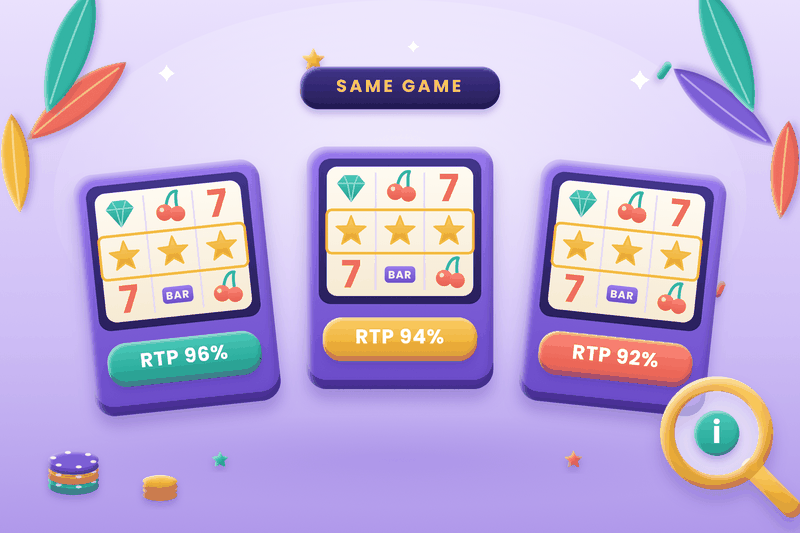
Here’s the part a lot of players miss: one slot can exist in several RTP versions. Many providers release a game in a set of configurations, say a top setting around 96% and others several percentage points lower. The casino doesn’t always get to pick freely, either, as the version it runs can come down to its deal with the provider, the market it operates in and which versions are approved there. Nothing on the screen gives it away. Symbols, bonus round, music: all identical. What’s different is hidden in the probabilities or in how the payouts are spread. So don’t trust a figure from a press release. Open the info screen at the casino where you’re actually playing and read the RTP there. If hit frequency and max win are listed too, glance at those while you’re at it.
Licensing, Certification and Fairness
Do providers need a license of their own? Often, yes, but it depends on where their games go. Casino gaming software providers may need a separate supplier or gambling software license in one country and nothing of the kind in another. Where a market is regulated, the studio has its own technical standards and testing to deal with. That’s on top of whatever the operator needs for its license, not instead of it. The Malta Gaming Authority licenses software suppliers, for instance, and so does the UK Gambling Commission. Big studios often collect approvals from several regulators. If testing is mandatory, an independent lab normally does it: it runs the RNG, looks at what comes out and checks the maths really produces the RTP on the label. You’ll see GLI, BMM Testlabs, iTech Labs and eCOGRA mentioned a lot.
So what can you actually check? It takes about five minutes:
- Find the license list on the provider’s own website. Most studios publish their licenses and approved markets there.
- Look those licenses up on the regulator’s public register.
- Open the game’s info screen at your casino and read the RTP shown there, since a certificate covers one specific game version, not the setting your casino has switched on.
And keep a license in perspective. All it confirms is the studio’s regulatory status in that one jurisdiction. Staying compliant with every rule from now on isn’t guaranteed by it, and whether tonight’s session goes well is a different question entirely.
Mobile Compatibility and Performance
If a game came out in the last few years, it’s almost certainly HTML5 and it’ll run in your phone’s browser. No app needed. So the differences are in the fiddly stuff. Does it take forever to load on 4G? Is the spin button where your thumb actually is? Can you read the paytable, or are you pinching the screen? PG Soft builds a lot of its slots in portrait from the start, which is why they feel natural on a phone. Some older desktop slots that got shrunk down later are a pain by comparison, with tiny buttons and everything crammed together.
Weak phone, patchy signal? Live tables will be the first thing to suffer. Studios that use adaptive streaming let the picture go blurry for a few seconds instead of freezing the whole table mid-hand, which is a lot less frustrating, and one or two even offer a low-bandwidth view. You still won’t really know until you try it on your own phone, on the Wi-Fi or mobile data you’d normally use, with a demo or a couple of minimum-stake rounds. That tells you more than any provider spec sheet.
How Casino Software Providers Influence Your Gaming Experience
The casino decides which games you can open. After that, it’s mostly the online casino game providers in charge. Graphics, animation and sound are the obvious part. The rules are less obvious. Does the slot have a feature buy? Can you double after splitting at this blackjack table? How long do you wait between crash rounds? Spin speed and quick-spin options also change from one studio to the next, and some regulators cap them.
Availability is on the provider too. Some games are released only in certain regions. Some get local versions with different features. Two casinos might even run one title at two different RTP settings. Ever had a favorite slot feel tighter at a new site? Before blaming luck, have a look at the info screen. The configuration may simply be different. The online casino games hub sorts titles by type if you’d like to compare formats side by side.
How SlotsReview Reviews Casino Game Providers
Every studio in the casino game providers list above gets the same treatment, so comparisons are fair. The aim isn’t to crown the best casino game providers by reputation. What matters is what each studio makes and how its games work, backed by information you could check yourself.
Every provider review goes through the same four stages:
- Portfolio. What does the studio actually make, and what is it known for? I also compare its latest releases with the older back catalogue, because a studio coasting on one hit from years ago looks very different from one that keeps trying new things.
- Maths. A line like “RTP up to 96.5%” on a game page, with no mention of lower versions, gets noted in the review. So does a provider that hides max win or volatility.
- Technical side. Is there a demo, does the mobile layout work, does the game load properly in a browser?
- Licensing and testing. When a provider claims a license, the review goes and looks for it on the official register. Certification claims only go in when they can be traced back to the regulator or the lab.
Some numbers just can’t be confirmed. Total game counts are the classic case (every studio seems to count them its own way), so those stay out. A review gets reopened when a studio changes owner, launches a new product line or starts presenting its game data differently.
Final Thoughts
Casino game providers shape your play far more than a small logo in the corner suggests. The maths is theirs, the features are theirs, and quite often a game leaves the studio in several RTP versions, with the casino’s contracts and local rules deciding which one you end up with. Get to know how a studio likes to build its games and you’ll spend less time on ones that were never going to suit you. Long session? A mid-volatility slot. Something to watch? A game show. Five spare minutes? A crash round. And whichever you go for, look up the RTP on the info screen, try the demo first if it’s there, and keep in mind that the house edge doesn’t go away.