

8.3
SR SCORE390% up to €3,700 + 175 FS over 3 deposits15-level Crown Route loyalty · Wagering 40x · 7 days
Want to play blackjack online? Start with the free demo games, then compare the casinos that run real money tables. The basics take minutes to pick up. The rules are another matter: they vary from game to game and can shift the odds a lot. This page covers the games, the casino rankings, and how payouts, variants and strategy actually work.
Our ranking compares online blackjack casinos based on their game selection, betting limits and playing conditions. We also look at how bonuses treat blackjack bets and how withdrawals are handled. The order reflects our editorial view. It isn’t a promise of results, and you should check that a casino accepts players from your country.
18+ · T&Cs apply · We may earn a commission when you join through our links. It never changes a score. How we rate · How we make money
Online blackjack is a card game where you’re playing against the dealer, not the other players. Their decisions don’t determine whether your hand wins or loses. You want a total closer to 21 than the dealer’s, and if you go over (bust), the hand is lost on the spot. It doesn’t matter if the dealer busts a moment later.
You’ll come across two formats at any online blackjack casino. RNG games are pure software. The cards come from a random number generator and a round takes seconds. Most titles also reshuffle the virtual shoe after every hand, so there’s nothing to gain from tracking cards. Then there’s live dealer blackjack, with a real croupier and a real shoe in a studio. It’s slower, there’s a betting timer, and the minimum stake is usually higher.
You don’t need long to learn this. An evening of practice is usually enough to play blackjack online without second-guessing every move. Rounds always go in the same order, and most of the time you’re only asking yourself one thing: another card, or stop? Doubling, splitting and surrender come up now and then.
A 7 is worth 7, a 9 is worth 9, and so on up to 10. Picture cards (king, queen, jack) are 10 each. The ace is where it gets interesting: it’s either 1 or 11, and the software picks the value that’s better for your hand. Players call a hand “soft” while the ace is still counting as 11. Take an ace plus a 6. That’s soft 17, and since the ace can drop to 1, another card can’t push you over 21. A 10 with a 7 is hard 17, and that one can bust.
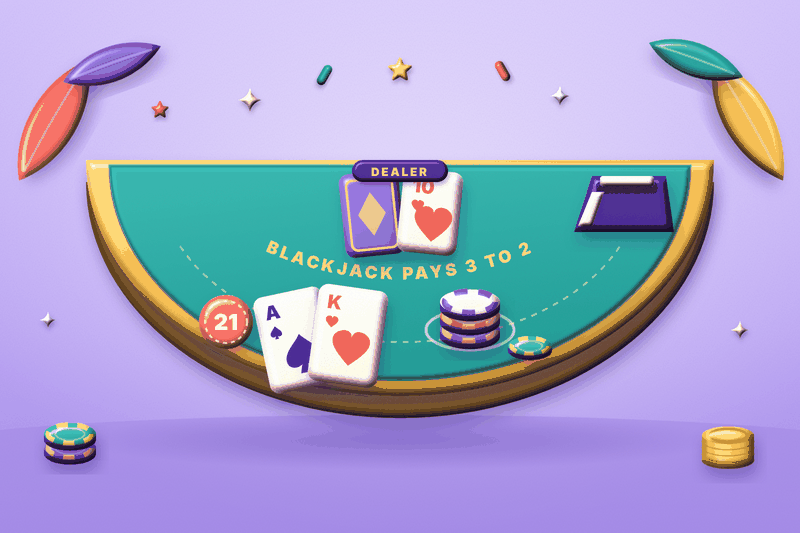
Two cards, an ace and anything worth 10: that’s a blackjack, or natural. A three-card 21 doesn’t beat it, and at a standard table it pays 3:2. As for the dealer, there’s no thinking involved. Under 17, they draw. On 17 or above, they stand, with one wrinkle. Soft 17 is handled differently depending on the game, since some have the dealer hit it and some have them stand.
Which options you get depends on the cards and on the table:
Some tables don’t use a hole card at all. There, step 3 is skipped and the dealer’s second card only arrives once you’re done.
Underneath the branding, most online blackjack games come from a small number of rule sets. The name on the tile won’t tell you much. Two games can both be called “Classic Blackjack” and still pay naturals differently, handle soft 17 differently and end up with different RTPs. Read the rules panel, not the title.
Ask most players what classic blackjack looks like and they’ll describe several decks, a hole card for the dealer, 3:2 on a natural and a dealer standing on soft 17. That’s the usual setup, but providers don’t all use the same settings under that name.
European blackjack is a different animal. It’s often dealt from two decks with no hole card, and the dealer’s second card only comes after you’ve played your hand. The consequence catches people out: in many versions, a dealer blackjack wins your doubles and splits too, not only the original bet. Not always, though. Some no-hole-card games use Original Bets Only (OBO) rules, which protect those extra stakes, so check the table you’re at. Expect doubling to be limited to hard 9, 10 or 11 in a lot of European games as well.
With standard American hole-card rules, the dealer takes a second card face down. If the upcard is an ace or a 10-value card, there’s a peek for blackjack before anyone can double or split. Dealer has it? The round is over, and no additional stakes are lost to an immediate dealer blackjack. The standard version pays 3:2 for a natural, and you’ll sometimes get late surrender. Online versions tend to use several decks. Some also have the dealer hit soft 17, which costs the player a little. One caution: “American Blackjack” on a game tile doesn’t promise every standard rule. The help screen does.
In multi-hand blackjack you can open several boxes at once, usually three to five, all playing against one dealer hand. Per hand, the house edge is unchanged. Per round, though, you’ve got far more money on the table, and a budget goes quicker than the stake on a single box would make you think.
Single-deck games look tempting, and fewer decks do help the player a bit. The catch is what usually comes with them: 6:5 on naturals, restricted doubling, or no doubling after a split. Here’s the comparison that surprises people: a six-deck shoe paying 3:2, with the dealer standing on soft 17, usually gives the house a smaller edge than a single deck paying 6:5. So yes, deck count matters. The natural payout matters a lot more.
Live blackjack gives you a real dealer and real cards on screen, with buttons for your decisions. It’s slower than RNG play, and some people prefer it for exactly that reason: you watch every card come out of the shoe. The rule checks don’t change, so look at the natural payout and soft 17 first. Formats differ more than you’d expect. Some tables have a set number of seats, others let any number of players bet on one shared hand, and side bets turn up often. Our live casino guide goes deeper into studios and table types.
In most cases the free version and the paid version are the same game underneath. You just use them for different things.
| Free blackjack | Real money blackjack | |
|---|---|---|
| Registration | Usually not needed | Account and identity checks required |
| Financial risk | None, virtual chips only | Your own funds at stake |
| Withdrawals | Not possible | Possible under the casino’s terms |
| Practice value | Learn rules and test decisions | Every mistake has a real cost |
| Availability | Most RNG games; live tables rarely | RNG and live tables |
Demo credits aren’t money. Whatever the balance says, free games can’t produce winnings you can withdraw. I find demo mode most useful for one job: seeing how a particular game handles doubles, splits and surrender before any money is involved. Then you play online blackjack for real money, and now the house edge is working on every hand. My rule: set the amount you can afford to lose first, not halfway through a bad run.
RTP (return to player) is the part of all stakes a game pays back over a very large number of hands. Whatever it keeps is the house edge. Blackjack RTP figures come with a catch: they assume perfect basic strategy for that exact game. With favorable multi-deck rules, the theoretical RTP can reach about 99.5%, an edge of around 0.5%. That figure isn’t fixed, though. The number of decks, the dealer rules, doubling restrictions and the blackjack payout all move it.
| Rule | Player-friendly option | Why it matters |
|---|---|---|
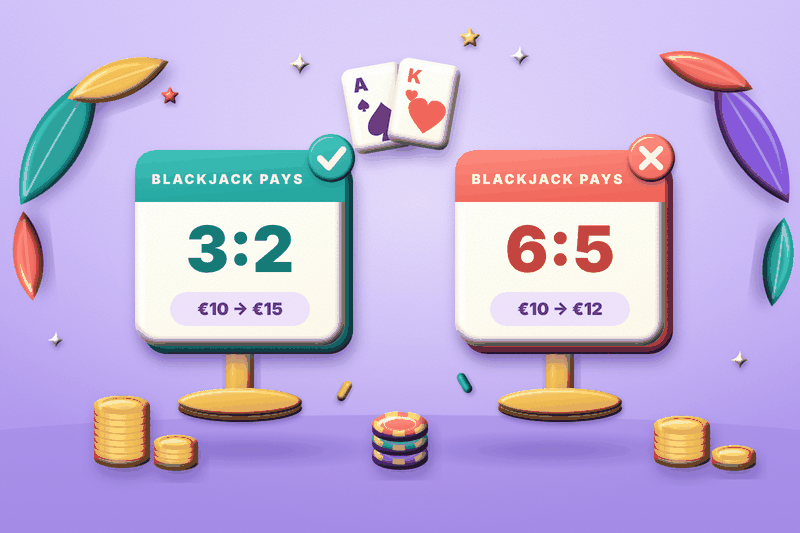
| Blackjack payout | 3:2 | A higher payout for a natural; 6:5 adds about 1.4 percentage points to the house edge |
| Dealer soft 17 | S17 | Usually a lower house edge than H17, by about 0.2 percentage points |
| Double after split | Allowed | More chances to double strong hands after splitting |
| Surrender | Available | Can reduce expected losses on a few weak hands, such as hard 16 against a 10 |
Here’s how much the payout alone can cost. A €10 natural earns €15 at a 3:2 table. At 6:5 you get €12. Scale it up to €1,000 in total bets. At a 0.5% edge the expected loss is about €5. Make it 6:5 and the edge rises to roughly 1.9%, so you’re looking at about €19. Those are averages over the whole turnover, nothing more. Your actual session could finish well up or well down.
Basic strategy is a chart. Find your hand down one side and the dealer’s upcard across the top, and it gives you the mathematically best move. Following it gets the house edge as low as the rules allow. The edge doesn’t vanish, though. You’ll still have losing sessions, sometimes several in a row.
Start with the dealer’s upcard. Showing 2 to 6, the dealer is more likely to bust. Showing 7 to ace, they’ll usually end up with a strong total. In most multi-deck games:
The table rules move some of these lines. Take away the hole card and doubling 11 against a 10 becomes a mistake. At an H17 table, a few extra doubles appear on the chart. Doubling 11 against an ace is one of them.
A big lobby doesn’t make the best online blackjack casino. Good rules at the tables do. What follows is about blackjack only. Payments, support and the other general points are in our list of the best online casinos.
Finding a blackjack casino online takes seconds. Finding one with good tables takes longer. At any strong blackjack casino I’d want to see RNG and live games from more than one software provider, plus at least one table that pays 3:2 with the dealer standing on soft 17. Stakes are the next thing. Digital tables tend to accept tiny bets, and live tables usually start higher. High rollers should look at the table maximum too, and at any rule in the terms that caps winnings from a single round. Comparing online blackjack sites this way tells you far more than a game count does.
Before you register at a blackjack online casino, look its license up on the regulator’s public register. Our guide explains how to verify a casino license. For RNG blackjack I’d stick to established providers with software tested by independent labs. It also helps when the help screen shows the game’s RTP. Before you place a chip, you should be able to see what a natural pays, how the dealer handles soft 17, where doubling and splitting are limited, whether surrender exists and how many decks are in the shoe. If a game keeps those details hidden, I skip it. The bonus attached doesn’t change that.
Many casino bonuses are designed with slots in mind. Blackjack often counts for only part of the wagering, 10% or less being common, because its low house edge would make bonuses too easy to clear. Take a 10% contribution. In practice, a €20 blackjack hand clears €2. To get through a €3,000 requirement you’d need €30,000 in eligible blackjack bets, assuming the other terms even let you play blackjack with the bonus. None of this is standard: contribution and maximum bet rules come from each promotion, and some offers don’t count blackjack at all. Before you claim, find the contribution table, the maximum bet while wagering and the restricted games list. Our guide on how wagering requirements work has more examples.
You can play most blackjack casino games straight from a phone browser, on iOS or Android, without downloading anything. RNG tables generally work fine in portrait and give you large hit, stand, double and split buttons. Live tables are a different story. I’d hold the phone sideways, since the stream and the betting panel need the width. It’s easy to hit the wrong button with a thumb, so check the chip value before each deal, and check again after a double. Don’t expect every desktop game on mobile either, since lobbies can differ by device. Our mobile casinos page has more on browser play and apps.
There are really two questions here. Is the game fair? And is the casino safe to play with? For the game, independently tested RNG software and properly regulated live dealer operations give stronger assurance. Labs look at whether the virtual shuffle behaves randomly and whether payouts match the published rules.
The casino needs its own look. Check who licenses it, whether it publishes its game rules, and what player protections it offers. Don’t expect too much from the license, either. It covers certain markets, sets standards for fairness, player funds and complaints, and decides how a dispute is handled. It doesn’t decide who wins it.
Then there’s the legal side, which depends entirely on where you live. Some countries license online casinos. Others restrict them. A site loading on your screen tells you nothing about whether you’re permitted to use it, so read your local rules and the casino’s accepted countries list.
Set limits before you play, not after. Deposit caps, session reminders, cooling-off periods and self-exclusion all exist for that reason. You’ll find more help on our responsible gambling page.
My one piece of advice: read the rules card before anything else. A 3:2 payout, the dealer standing on soft 17 and generous doubling will help your expected return more than a welcome bonus can. Try new variants in free mode. Use a strategy chart built for your exact game rather than a one-size-fits-all version. Then compare the best blackjack casinos on their table limits and on how much blackjack counts toward bonus wagering. Keep the budget fixed, because the house edge doesn’t go away just because a session runs long. Curious about other table games? Our online roulette games hub and the wider guide to online casino games are good next stops.
Yes. In many cases you don’t even need an account. Many casinos and providers have RNG demos with virtual chips, and that’s where I’d learn the rules and try out decisions, since nothing is at stake. Demo wins can’t be cashed out, though, and you’ll rarely find a free mode at live dealer tables.
Yes. Find a licensed casino that takes players from your country, open an account, verify your identity and deposit. After that, winnings at real money tables can be withdrawn under the casino’s terms, and there are normally both RNG and live tables to pick from.
I’d point a beginner to a plain RNG table. Look for 3:2 on naturals, a dealer who stands on soft 17 and a low minimum bet. Nobody rushes you there. Most come with a demo, and charts for these rules are easy to find.
RNG blackjack is software. Cards appear instantly, there’s no timer, and the shoe is usually reshuffled every hand. Live blackjack streams a human dealer with real cards. You get a betting clock and, often, a higher minimum. Whichever you choose, check that game’s own rules.
There’s no single number. Take a multi-deck game with 3:2 naturals and the dealer standing on soft 17: with perfect basic strategy it can return about 99.5%. Drop the payout to 6:5 and you’re nearer 98%. Every mistake costs a bit more.
Yes, and some sessions do end in profit. The longer you play, though, the more the house edge shows: on average, the casino keeps a small share of all stakes. No strategy guarantees winnings, basic strategy included.