






What Are Casino Payment Methods?
In plain terms, casino payment methods are how your money gets into your account and back out again. Think Visa, Skrill, a bank transfer, Apple Pay, a Paysafecard code, some Bitcoin. None of them is a straight line from you to the casino. There’s a payment processor in the middle, and on your side a bank, a wallet company or a blockchain.
Why care? Because every link in that chain can say no. A provider can refuse gambling payments, charge extra for them or serve only certain countries. The casino then picks what to switch on, and in which direction. So two casinos can show the same logo and treat it completely differently. A logo in the footer tells you a method exists somewhere in the cashier. It doesn’t tell you it will be available for your account, in your country, in both directions.
Types of Online Casino Payment Methods
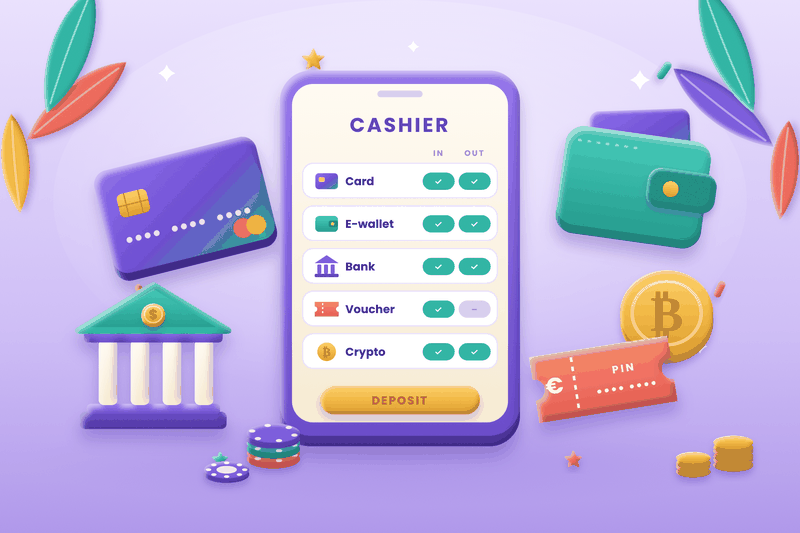
Most online casino payment options fall into five groups. The deposit side rarely separates them much; it’s usually a few clicks either way. The real gaps show up later. Can the method take a withdrawal? Who adds a fee? How much ID checking comes with it? Quick notes on each group follow.
Credit and Debit Cards
Visa and Mastercard are the most familiar way to fund a casino account. Withdrawals are a different story. Some casinos return funds to the same card, others pay card users by bank transfer, and some don’t offer card payouts at all.
Then there’s your own bank. Some refuse gambling payments outright. Others let a credit card deposit through but book it as a cash advance, so you may pay a fee plus interest that starts straight away. In some places credit cards are off the table for gambling completely; the UK Gambling Commission banned them, for example. If a card deposit keeps getting declined, check with your bank before assuming the casino is at fault.
E-Wallets and Digital Payments
Skrill and Neteller can reduce how often you share card or bank details with the casino directly, because the payment runs through the wallet. That isn’t anonymity. The casino still verifies who you are, and the wallet holds your details too. Payouts to a wallet can also land sooner than card or bank payouts once approved, but that’s down to the operator, not the wallet.
There are two catches. PayPal only works with gambling merchants it has approved, and only where the activity is legal, so it rarely shows up at the casinos SlotsReview covers. The other one is bonuses: a few casinos won’t count e-wallet deposits toward their welcome offers.
Apple Pay and Google Pay are a separate case. They’re really your card in a phone wrapper. A casino may happily take them for deposits and still send your winnings some other way.
Bank Transfers and Instant Banking
Old-fashioned bank transfers go straight from your account to the casino and back. Limits tend to be higher. The downside, especially across borders, is cost and time: intermediary banks can take a cut, there may be a currency exchange, and settlement can drag over several business days. Forget the payment reference some casinos ask for and your deposit may sit unmatched for a while.
Instant banking works through your banking app instead. You log in, approve, done. Trustly is a well-known example in Europe. Availability depends on the country your bank is in, and a provider that supports payouts doesn’t guarantee every casino using it offers them. More on timing and charges on the bank transfer page.
Prepaid Cards and Vouchers
Paysafecard and similar vouchers are for people who’d rather not connect a bank at all. You buy a code, you enter it, you play. That makes spending easy to cap, since you can’t load more than the voucher holds. Getting money back out is the problem. Vouchers usually can’t receive withdrawals, so you’ll need a second method, verified, for any win.
People sometimes buy vouchers hoping to skip ID checks. Doesn’t work. You’ll still be asked for documents before any payout, and past a certain amount the voucher company wants to know who you are as well.
Cryptocurrency Payments
Crypto skips the banks and moves on a blockchain. At most casinos that take it you’ll see Bitcoin, Ethereum and a stablecoin or two. Many pay out in crypto too. Just not always in every coin, and the minimum can be different on the way out. Speed? That’s the network’s mood plus however many confirmations the casino insists on. Costs come from two places: the blockchain’s network fee, which moves with demand, and the casino’s own withdrawal fee. Some casinos pass the network fee on, others charge a fixed amount whatever the network costs.
Before any crypto deposit, check the network first. Tether (USDT) is the classic trap: the same token runs on several blockchains, and if you pick one the casino doesn’t support, the money may fail to arrive or simply be gone. Nobody can reverse it. Price swings are the other risk: a Bitcoin balance can drop in value between your deposit and your payout.
How to Choose the Best Casino Payment Method
Ask ten players for the best online casino payment methods and you’ll hear ten answers, mostly shaped by their country and habits. Skip the favorites. Run these six checks instead, more so at a casino you’ve never used.
- Security. Padlock in the address bar on the cashier page, a provider you’ve heard of. Wallets and banking apps add their own password or a phone code, so a thief needs more than your casino login.
- Speed. People mix up two things here. A deposit landing in seconds is nice, but it says nothing about payouts, and payouts are the speed that counts.
- Fees. Check the casino, the provider and your bank separately. A casino saying “no fees” is only talking about itself.
- Limits. The minimum deposit is the number casinos advertise. The withdrawal minimum, and the cap per payout or per month, are the ones that bite. A cheap entry means little if the payout floor sits much higher.
- Withdrawal availability. A method being in the cashier isn’t the same as it paying out to you, from that casino, in your country. If it doesn’t, find out the fallback before your first deposit, not after a win.
- Bonus compatibility. Some offers ignore deposits made with certain methods, usually e-wallets or crypto. If you’re planning to grab something from the casino bonuses section, read that part of the terms first.
One more thing, and it’s not about the method: decide what you’re willing to spend before you start. Fast deposits make overspending easy.
Casino Deposits vs Withdrawals
With most online casino payment methods, paying in and cashing out are not mirror images. A deposit is easy for the casino to accept. The provider has already approved it and the money is arriving. A withdrawal is money leaving, so it gets checked, and it can only go out through channels the casino has actually set up for payouts. That’s why the deposit list in a cashier is often long and the withdrawal list noticeably short.
Then there’s the closed-loop rule some casinos apply. Winnings go back to the method you paid in with, up to what you deposited, and anything beyond that goes by bank transfer or another method you’ve verified. It’s there for anti-money laundering reasons. It’s also why a casino may say no when you ask to be paid into a different wallet from the one you used.
KYC is where most first withdrawals slow down. You’ll be sending a passport or ID card, a utility bill or bank statement, and now and then a photo of the card you paid with. After that, a typical payout goes through four stages:
- Withdrawal request:you pick an eligible method and amount.
- Casino approval:the pending period, KYC and payment checks.
- Provider processing:the wallet, bank or blockchain moves the money.
- Receipt of funds:the money reaches your account or wallet.
A “24h payouts” banner might only be talking about the second stage. The fast withdrawal casinos guide goes through each step.
So before depositing, check that the casino pays out through your chosen method and what verification it will ask for. Finding out afterwards is how players end up stuck with a balance they can’t move.
Casino Payment Fees, Limits and Processing Times
With casino payment methods, fees hide in four places:
- The casino may charge on deposits or withdrawals, sometimes only for certain methods or once you go past a few free withdrawals a month.
- The provider may take a cut, for instance when you move money from your e-wallet to your bank.
- Your bank can add foreign transaction or cash advance fees.
- The blockchain charges a network fee on crypto, and the casino may set its own withdrawal fee on top.
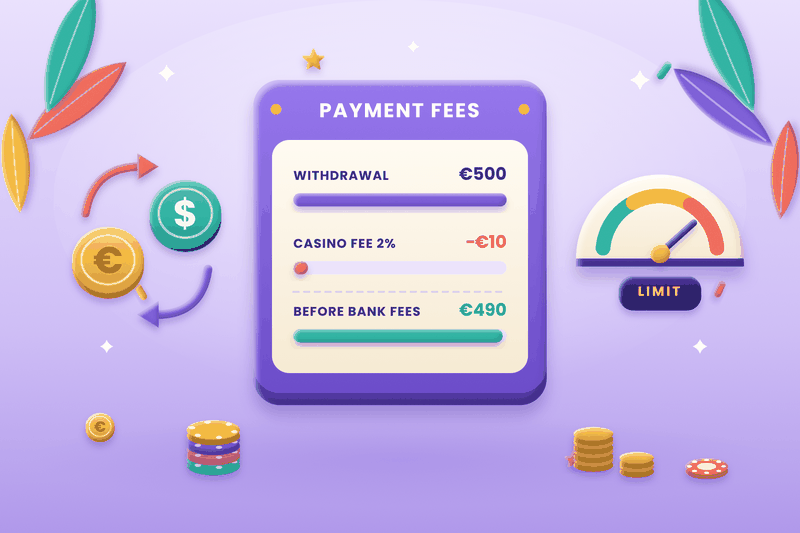
A quick example. Say a casino takes 2% on withdrawals. Cash out €500 and €10 is gone before your bank or wallet charges anything of its own.
Currency conversion is the one people tend to miss. Suppose your account runs in euros but your card is in another currency. You lose on the exchange spread going in, then again coming out. That can easily cost more than any fee on the casino’s list. Some casinos let you choose the account currency at registration. Pick the one your card or wallet uses, where that’s offered, and a conversion or two disappears. Not every charge goes away, mind. Bank, provider and casino can each still apply a rate or a fee.
Limits stack too. The casino has its own minimums and maximums per method, and often daily, weekly or monthly withdrawal caps on the whole account. The provider has separate transaction limits. Whichever is lower is the one you’ll hit. Crypto adds a minimum for each coin on top.
Hardly anyone complains about deposit speed. A card, wallet or instant banking payment shows up soon after approval, with bank transfers and blockchain confirmations a step behind. Payouts are another matter, and two clocks run separately. One is casino processing: the pending period, any checks and the approval itself. The other is the provider’s transfer once the money is released. A pending period, a document request or a payments team that doesn’t work Sundays affects the first clock far more than the method affects the second. That’s in the withdrawal policy, which is worth ten minutes of your time.
Are Online Casino Payment Methods Safe?
Cards and crypto aren’t protected the same way, and that matters more than most people think. Card networks and most payment providers run fraud monitoring and let you dispute a charge that looks wrong. Crypto works differently. The blockchain itself verifies each transaction, there’s no chargeback route, and a confirmed one generally stays final. Problems can start on either side: payment errors, hacked accounts, phishing and provider issues all happen. And a secure payment method doesn’t make the casino trustworthy, any more than it counts as a gambling license.
So if you want safe casino payment methods, vet the operator as well as the method. Look up the license with the regulator named on the site. Read the withdrawal terms, the boring bits included. Search public complaint records for players who never got paid. Then weigh the safety net, which is thinner than people expect: banks may turn down a gambling chargeback, wallet disputes run on the wallet’s own rules, and crypto gives you none at all.
Red flags worth knowing:
- A request to pay into someone’s personal bank account, or to a wallet address sent in a chat.
- Being told to pay a “release fee” before you can withdraw.
- A payment page that suddenly jumps to a domain you’ve never seen.
Turn on two-factor authentication for your wallet and casino accounts, and never hand over a card PIN, a banking password or a wallet recovery phrase, not even to casino support.
Casino Payment Methods by Country
Log in from Toronto and then from São Paulo and the casino payment options in front of you can look completely different. Registration country and account currency decide what shows up, and in a lot of places the local option beats any global brand.
Canadian players will know Interac, and casinos targeting Canada often list it. In Brazil, a huge share of online payments go through Pix, the instant system run by the central bank, and casinos serving Brazilian players follow suit. Trustly turns up a lot in Europe, but only for banks in the countries it covers. Elsewhere it’s banking apps, a regional wallet or vouchers bought with cash. Even within one country the picture isn’t fixed. Your bank, the operator, the provider’s gambling rules for that market and the specific product all play a part, so two neighbors can see different cashiers.
Two things don’t change with the map. Seeing a method in the cashier doesn’t mean online gambling is legal where you live. That’s down to local law, not the payment company. And governments can cut methods off directly, for instance by banning credit cards for gambling or restricting crypto. Check the casino’s restricted countries before you register.
Which Casino Payment Method Should You Use?
Forget the idea of one best method; it comes down to what you need it for.
- Less sharing of card details: a wallet can reduce how much you share, though you’ll still pass KYC.
- A hard spending cap: a voucher works for deposits, provided you’ve got a payout method sorted.
- Bigger sums: a bank transfer may suit, where the casino sets higher limits for it.
- Coins you already hold: crypto casinos make sense, as long as networks don’t confuse you.
And if you only remember one thing: pick something you can withdraw to as well. Then go to the best online casinos ranking and shortlist from there.